


Human evolution is the long biological history of our species, while the growth of consciousness describes how people develop awareness, responsibility, and the ability to live with others. These processes are connected, but they are not the same. Understanding the difference helps readers explore our origins without mistaking technological power for human maturity.
Key insights
- Human ancestry is a branching family tree, not a ladder of species marching toward perfection.
- Upright walking, tools, larger brains, and symbolic expression emerged at different times.
- Biological evolution changes populations across generations; personal growth can happen within a lifetime.
- Human capabilities create choices, but they do not guarantee ethical or conscious behavior.
- Everyday decisions shape the quality of our shared future, even when they do not change our genes.
Human evolution is a branching process, not a ladder
Human origins are best understood as a branching history of populations adapting over millions of years. Fossils, genetics, artifacts, and other evidence help scientists investigate changes in bodies, movement, diet, and behavior. The Smithsonian overview of human evolution describes a lineage that developed over roughly six million years.
Humans did not descend from the chimpanzees or bonobos alive today. Our lineage and theirs share earlier ancestors. Many human species existed, and the fossil record shows that traits did not arrive as one complete package. Upright walking appeared before several later developments, while symbolic expression and agriculture belong to much more recent chapters.
Homo sapiens emerged in Africa around 300,000 years ago. Fossils from different parts of the continent suggest that our origins involved populations across a wide region, rather than one simple, isolated starting point. The evidence for early Homo sapiens also shows why scientific accounts can change as researchers discover and date new remains.
How did upright walking and shared learning shape our lineage?
Upright walking is one of the earliest known defining traits of the human lineage, appearing more than four million years ago. It developed long before modern humans. Fossil evidence helps researchers examine how bodies changed, but it does not reveal one simple reason or moment when our ancestors began walking upright.
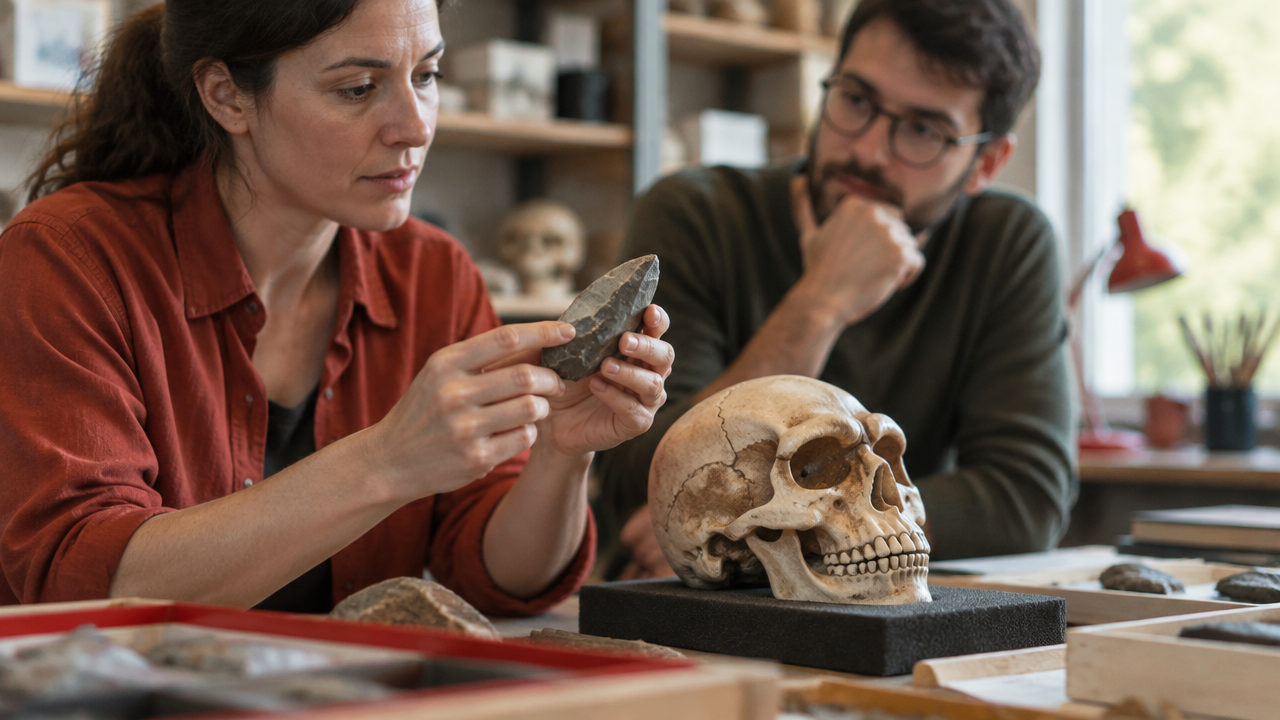
Other changes followed on different timelines. Stone tools preserve clues about skill and innovation, while hearths and shelters offer evidence that early humans gathered to eat and socialize. The Smithsonian’s record of early human behavior includes tools, footprints, art, and other traces that help researchers reconstruct how people lived and learned.
These clues matter because survival was not only about an individual body. Skills and information could be shared, adapted, and passed between people. A stone tool is evidence of practical knowledge; it is not, by itself, proof of compassion or moral progress. The distinction keeps our account of human history grounded in evidence.
Biological change and conscious growth are not identical
Biological evolution describes changes in inherited traits within populations across generations. It does not mean that an individual becomes a new species by working on themselves. Conscious growth, by contrast, can describe a person becoming more aware of emotions, assumptions, and the effects of their choices.
This distinction offers a useful lens for thinking about human development. Greater knowledge or control over the environment can expand what people are able to do, but it does not automatically make those actions thoughtful or fair. A society can gain powerful tools while still responding to fear, conflict, or short-term advantage without reflection.
Within a consciousness-centered view of evolution, growth is therefore measured not only by capability, but also by responsibility and coexistence. That is an ethical interpretation of human development, not a biological definition. Reflecting on how personal thoughts affect collective life can help connect inner habits with their wider impact.
What does conscious growth look like in daily life?
Conscious growth becomes practical when people pause between an emotional reaction and an action. The goal is not to eliminate anger, fear, or disagreement. It is to notice what is happening, consider who may be affected, and choose a response that does not turn an unexamined feeling into avoidable harm.
For example, a team leader who feels criticized might blame a colleague immediately, or ask what part of the feedback is useful before replying. The second choice does not settle every disagreement, but it creates room for accountability and repair. Similar choices occur in families, friendships, workplaces, and public life.
- Name the feeling before assigning blame.
- Check whether an assumption is being treated as a fact.
- Consider the effect of a decision on people beyond the immediate group.
- Repair harm when it is possible, instead of defending it automatically.
Recognizing emotional triggers that limit reflection can help people respond with more choice. Practicing responsibility for collective impact makes that awareness concrete in everyday relationships.
Can we predict how humans will evolve next?
No one can reliably predict the physical appearance or behavior of humans thousands of years from now. Biological changes may continue, but evolution is not a ladder with a predetermined destination. The conditions that shape future populations can change, and their effects cannot be reduced to a simple forecast.
It is also useful to separate biological predictions from questions about humanity’s future. Whether people will live safely, cooperate, or reduce harm by a particular year is not something evolution guarantees. Human choices can influence shared risks and resilience, but no single account of progress can promise survival.
A more useful question is what our current capabilities demand of us. If human impact reflects our collective state of awareness, then progress includes examining how decisions affect other people and the living world. That does not make evolution inevitable or purely individual. It makes responsibility a meaningful part of how we shape the future together.
Frequently asked questions
What are the key milestones in human evolution?
Major milestones include the emergence of upright walking more than four million years ago, the development of tools, changes in brain and body size, symbolic expression, and the appearance of Homo sapiens in Africa around 300,000 years ago. These changes happened at different times across a branching family tree, not in a single sequence.
Is Darwin's theory 100% true?
No scientific theory is treated as permanently beyond revision, but evolution is strongly supported by evidence from fossils, genetics, and other fields. Research refines how scientists explain particular changes and relationships. Evolution also does not mean humans descended from modern apes; humans and other living apes share common ancestors.
How did humans evolve to walk upright?
Upright walking emerged early in the hominin lineage, more than four million years ago. Scientists study fossils to understand how bodies adapted to bipedal movement, but there is no single confirmed explanation for why it developed. Multiple environmental and practical pressures may have contributed over time.
How will humans evolve in 10,000 years?
No one can reliably predict what humans will look like in 10,000 years. Inherited biological changes may continue, but their direction depends on many factors, including environments and reproduction. Cultural and technological change may reshape human life much faster than genetic change, without making evolution a goal-directed process.
Will humanity survive until 3000?
No one can know with certainty whether humanity will survive until the year 3000. Evolution does not guarantee survival or progress. Human choices can influence collective risks and resilience, but responsible action is not a promise of safety. It is a way to respond to uncertainty with care and shared responsibility.