

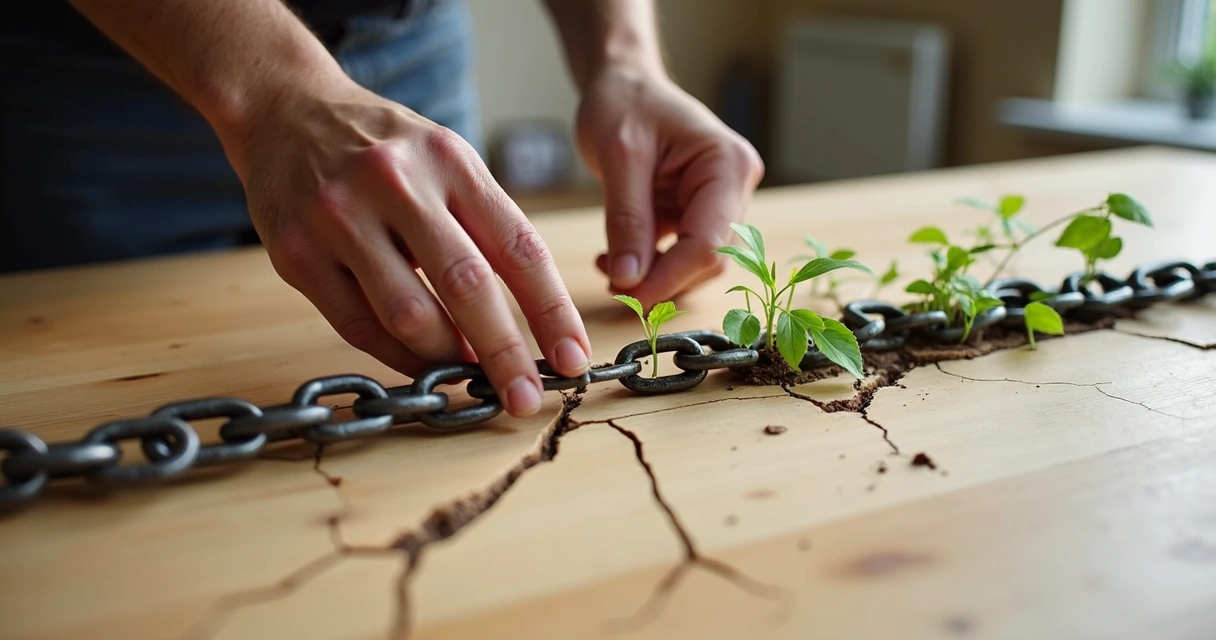
We often think generational patterns are huge, fixed, and hard to move. In our experience, they can feel that way because they live in ordinary moments. They show up in how we react, avoid, speak, judge, and protect ourselves. A family pattern is rarely passed down as a formal lesson. It is passed down in tone, silence, fear, and repetition.
Generational patterns change when we interrupt them in small daily moments.
Many of us have seen this in simple scenes. A parent snaps because stress was never named in their home. A son hides sadness because no man was allowed to look fragile. A daughter apologizes for having needs because she learned that peace mattered more than truth. These acts seem personal, but they often began long before us.
Small acts break old cycles.
This does not mean we blame the past forever. It means we notice what the past trained into the body. Then we practice something new, again and again, until a different inner response becomes possible.
Why patterns stay alive
Patterns continue because they once helped someone survive. A grandparent may have learned emotional distance in a hard home. A parent may have learned control in unstable conditions. We may inherit the result without knowing the original pain.
That is why shame does not help much. If we only call ourselves broken, we stay stuck. If we become curious, we begin to see structure. We start asking better questions:
What reaction appears in me before I think?
What feeling was not welcome in my family?
What role did I learn to play to be accepted?
When we ask these questions with honesty, patterns become visible. Once visible, they are no longer fully in control.
Public health data also shows how early experiences shape later life. Global findings on child maltreatment and lifelong health risk show that many children face violence or abuse, and early adversity is linked to mental, emotional, and physical struggles later on. This helps us see that repeated family pain is not abstract. It leaves marks, and those marks can echo across generations.
What micro-actions really do
Micro-actions are small behaviors done on purpose. They are not dramatic. They do not require a perfect mood. They work because they train the nervous system, not just the mind.
A micro-action is a small repeated choice that teaches the body a new way to respond.
We think this matters because most people try to change patterns only during major emotional events. But a pattern is built in ordinary life. So the reset must also happen there.
Let us make this concrete. If we grew up around criticism, a micro-action may be pausing before giving feedback. If we inherited silence, the micro-action may be saying one honest sentence each day. If we learned to please others, the micro-action may be waiting ten seconds before saying yes.
These are tiny acts. Still, they create new internal evidence. The body begins to learn, "I can stay present and choose differently."

Daily micro-actions that reset family conditioning
We have found that the best micro-actions are simple enough to repeat and clear enough to measure. They should fit real life, not fantasy. Here are a few that can start shifting old patterns.
Pause before reacting. Take one full breath before answering when tension rises.
Name one feeling a day. Say, "I feel sad," or "I feel tense," without adding a long defense.
Replace one automatic apology. If no harm was done, say thank you instead of sorry.
Set one small boundary. Decline one request politely when saying yes would create resentment.
Use one softer sentence. Try, "Can we start again?" instead of "You always do this."
Track one trigger. Write down when, where, and with whom a strong reaction appears.
Each of these actions interrupts inheritance at the behavioral level. That is the point. We do not need a grand speech every day. We need repeated evidence that a new way is possible.
We once heard someone describe her shift in a very plain way. Every time her child spilled something, she felt an old wave of anger rise. That was familiar. That was inherited. Her micro-action was not becoming calm instantly. It was saying, "Let us clean it up," before the old tone took over. She said it felt awkward at first. Then one day, it felt normal. That is how change often comes. Quietly.
How to make micro-actions stick
Good intentions fade fast when they stay vague. We need structure. Not harsh structure, just enough to support repetition.
The best micro-actions are tied to moments that already happen every day.
We can anchor new behaviors to common situations such as meals, messages, conflict, or bedtime. That makes practice easier. For example:
Choose one pattern, not five.
Pick one daily moment where it appears.
Define one new action that takes less than a minute.
Repeat it for two weeks before judging results.
This lowers inner resistance. It also stops us from turning healing into another form of self-pressure.
We should also expect discomfort. A new response can feel wrong at first simply because it is unfamiliar. If our family system taught us that silence equals safety, speaking clearly may feel risky even when it is healthy. That sensation does not always mean we are doing harm. Sometimes it means we are stepping out of an old script.
What to do when the pattern is deeper than habit
Some patterns are linked to trauma, chronic fear, or years of emotional harm. In those cases, daily micro-actions still help, but they may need support from a trained professional. We say this with care, because not every cycle can be shifted by willpower alone.
There is strength in getting help. There is maturity in admitting that some reactions were wired through pain. Micro-actions remain useful because they support the work between deeper sessions of reflection or care.
For example, a person with a strong freeze response may begin with very small steps:
Feeling both feet on the floor during stress
Putting a hand on the chest before difficult calls
Writing one true sentence after conflict
These acts may look minor from the outside. Inside, they can be a new form of safety.
Conclusion
We do not reset generational patterns by waiting for a perfect breakthrough. We reset them by meeting ordinary life with more awareness, more honesty, and better choices. The old pattern may still knock on the door. But we do not have to invite it to lead.
Every daily micro-action tells the next generation what healing can look like in real life.
That is why this work matters. Not because it makes us flawless, but because it makes us more conscious. A softer tone. A clear no. A pause before harm. A truthful sentence. These are small things. They also change families.
Frequently asked questions
What are generational patterns?
Generational patterns are repeated emotional habits, beliefs, and behaviors passed through families over time. They can include silence, anger, guilt, people-pleasing, fear of conflict, or emotional distance. These patterns are learned through daily experience, not only through words.
How do micro-actions help reset patterns?
Micro-actions help by interrupting automatic reactions in real time. When we repeat a small healthier response, we teach the body and mind that another option exists. Over time, this weakens the old pattern and strengthens a new one.
What are examples of daily micro-actions?
Examples include taking one breath before answering in conflict, naming one feeling each day, replacing an unnecessary apology, setting one polite boundary, tracking a trigger in a notebook, or using a calmer sentence during stress. The best ones are small and repeatable.
How long does it take to see change?
Change can start quickly in awareness, but stable results often take weeks or months of repetition. Some people notice a shift in a few days because they catch the pattern sooner. Deeper family conditioning may take longer, especially when trauma is involved.
Is it worth it to reset patterns?
Yes. Resetting patterns can improve emotional safety, communication, self-respect, and family relationships. It also reduces the chance of passing unmanaged pain to others. The work is gradual, but the effect can reach far beyond one person.